Pondering the Passages: Philippians 3:7-11

This Weeks Memory Verse:  Philippians 3:7-8a “ But whatever was to my profit I now consider loss for the sake of Christ. What is more, I consider everything a loss compared to the surpassing greatness of knowing Christ Jesus my Lord…”

This Weeks Passage: Philippians 3:7-11

7 But whatever was to my profit I now consider loss for the sake of Christ. 8 What is more, I consider everything a loss compared to the surpassing greatness of knowing Christ Jesus my Lord, for whose sake I have lost all things. I consider them rubbish, that I may gain Christ 9 and be found in him, not having a righteousness of my own that comes from the law, but that which is through faith in Christ—the righteousness that comes from God and is by faith. 10 I want to know Christ and the power of his resurrection and the fellowship of sharing in his sufferings, becoming like him in his death, 11 and so, somehow, to attain to the resurrection from the dead.

Often times when I look at a passage there are questions that immediately spring to mind. Other times I am struck by phrases that stand out. As I pondered this passage there were particular words that grabbed my attention.

Whatever” – in other words Paul is saying that no matter how much success he has had from the world’s perspective none of it matters a hill of beans. Christ has captured his heart and Christ is his everything. Question I ask myself: Has my heart been unequivocally captured by Christ?

Surpassing” – It’s almost as if Paul cannot think of a superlative that would do justice to how he feels about knowing Christ. He was not content to just say the “greatness of knowing Christ”  – he had to add surpassing greatness. Question for me: Does knowing Christ mean anywhere near as much to me as it did to Paul?

Lord” – Paul could have stopped with”knowing Christ Jesus” and we would have gotten his point, but he went on to add “my Lord”. Why? What was he trying to communicate to his readers? In 2:11 of this book Paul declares that “Jesus Christ IS Lord”. Here, however, he declares that Jesus is “my Lord.” There is a big difference in knowing on the one hand that Jesus Christ IS Lord and on the other hand knowing Him as my Lord. For Christ to be Lord means that I have pledged allegiance to Him alone and completely surrendered everything about my life to Him – relinquishing control once and for all and allowing Him to dictate how I will live this life. Question for me: Have I done this?

Rubbish” – This is  one of my favorite words in the Greek New Testament. It is the word “skubala”. Here it is translated rubbish. Other translations have it as dung or refuse. What the word really means is “crap”. A few things I thought about with regard to crap: 1) Nobody is saving it up – you never hear anyone say, “Hey, I’ve got a bunch of really great crap I’ve been collecting, come on over to the house and I’ll show it to you” 2) It’s not something you would ever spend money on – there is no such thing as a Crap Store and I never see coupons like “20% off all our crap”  (- on second thought maybe you do.) 3) It actually started out as something good – but over time it devolved into something that is only good to flush away. 4) The best thing about crap is getting rid of it. It feels really good to get rid of all your crap. Conversely, there is this thing called impaction that is not only unhealthy but does not feel good at all – in other words, trying to hoard crap can actually be painful. 5) You never really hear people talking about their crap (unless you are in my middle school Sunday School class) – When is the last time you heard someone say. “Man I’ve gotta tell you about this great crap I had this morning.”

Now, put all this in the context of what Paul is saying in this passage. EVERYTHING to him was just a bunch of skubala compared to knowing Christ. Question for me: On a scale of 1-10, how much of a crap-lover am I? Am I willing to get rid of all my crap if it means I can know Christ better?

Found” – We all know the Amazing Grace verse “I once was lost but now am found…” I think for the most part we get the fact that we were completely lost. But I kind of think we equate our lostness to a game of hide and seek – where when the game is over if we still have not been found we come out of our hiding place and allow ourselves to be found. This is not the gospel AT ALL. We were so lost  that even if we tried to be found we never would be. The ONLY way we were ever found is that The Shepherd of our Souls went looking for us and did not give up until He FOUND us – wandering hopelessly and helplessly  and desperately in the desert of our eternal lostness. We try really hard to get found by doing all the right things, being “religious” enough, giving away enough, helping others enough. Paul is saying here that not only is all our crap worthless but so is our attempt to make ourselves holy by acting righteous. The ONLY way to be found, he says, is by…

Faith” – At first glance it would seem that God has made it much easier for us to be found. Quit trying to do do do (he’s already said that that is like do-do in His sight), instead just believe – have faith. Sounds easy right? It is easy… until you understand what saving faith really is. Let me try to define it as I am coming to understand it – then you tell me which is easier. Faith in Christ involves total surrender on my part. It is no longer about what I want or what I need or what I dream about. It is about Christ and what He wants. Faith says each day “I die to myself and live for Him.” Faith acknowledges that apart from Him I am nothing. Faith submits willingly and joyfully to His “whatevers” and completely discounts my whatevers. Faith acts intentionally and courageously to pursue a gospel centered, gospel saturated life. Faith boasts in the cross and the work of Christ – not in my efforts no matter how good they may be. Faith waits patiently for God’s timing instead of plowing forward with all my great ideas. Faith prays.

Just the act of writing all that out helps me recognize how puny my faith is compared to Paul. Not sure I’m really liking this passage now that I’m having to deal with and personalize it. Just a bit too convicting for me. I do however like the idea of the last word I will comment on:

Power” – The idea of power is intoxicating. And then I’m reminded that the kind of power Paul is talking about comes in a completely different looking package than what most of us want. Check out what Paul says in 2 Corinthians 12:9-10: “But (the Lord) said to me, “My grace is sufficient for you, for my power is made perfect in weakness.” Therefore I will boast all the more gladly about my weaknesses, so that Christ’s power may rest on me. That is why, for Christ’s sake, I delight in weaknesses, in insults, in hardships, in persecutions, in difficulties. For when I am weak, then I am strong. See, here is where Paul and I are 2 different cats. I, myself, delight in strength, in compliments, in encouraging affirmation, in easy times, in good health, in wealth, in fun. So far to go! So much to learn!

Okay, I realize this has been a very long post. So much in this passage that grabbed me. How about you? I’d love to hear what grabbed you as you pondered this passage. If you have questions or thoughts that you don’t want to post but want to dialogue about then feel free to e-mail me at sreyner@Ridgecrest.cc.

Next weeks passage: Hebrews 12:1-3
Next weeks memory verse: Hebrews 12:1

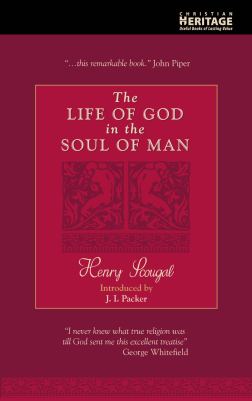
The Life of God in the Soul of Man: A Personal Review

The Life of God in the Soul of Man
by Henry Scougal

This book was written in the mid 17th century by a young man who was a Professor of Divinity at Aberdeen University by the age of 19, then pastored a church for several years before dying at the age of 27.

So why did I choose this book to read and review this week as I am intentionally trying to renew my mind? This is what John Piper says of this book: “There are some books whose vision is so deep and clear that truth rings from the page like the toll of a large bell, perfectly obvious, but rare and precious. They unfold the heart of man and God with such forceful illumination that the truth is not just shown to my mind but created in my heart…so it went as I grazed in the green pasture of this remarkable book.”

Personally, I did not find the book very easy to read as Scougal wrote in the language of his day. But as I marched through the pages of this short book (135 pages) I found several nuggets of truth that were worth the time to find and which challenged my heart while engaging my mind. If nothing else, I read the words of a man who was passionate about his desire for God and rigorous in his pursuit to know Him. Here are some of the nuggets I found – I will quote them without comment – as they speak for themselves. You will need to ponder them to fully understand them.

“Humility imports a deep sense of our own meanness, with a hearty and affectionate acknowledgment of our owing all that we are to the Divine bounty; which is always accompanied with a profound submission to the will of God, and great deadness toward the glory of the world, and applause of men.”

“The worth and excellency of a soul is to be measured by the object of its love.”

“Any person that is engaged in a passionate affection will easily forget his ordinary gratifications, will be little curious about his diet or bodily ease, or to divertisement he was wonted to delight in. No wonder, then, if souls overpowered by divine love despise inferior pleasures, and be almost ready to grudge the body its necessary attendance for the common accommodations of life, judging all these impertinent to their main happiness, and those higher enjoyments they are pursuing.”

“Let us frequently remember the shortness and uncertainty of our lives, and how that after we have taken a few turns more in the world, and conversed a little longer amongst men, we must all go down into the dark and silent grave, and carry nothing along with us but anguish and regret for all our sinful enjoyments; and then think what horror must needs fill our soul, to find itself naked and all alone before the severe and impartial Judge of the world, to render an exact account, not only of its more important and considerable transactions, but of every word that the tongue hath uttered, and the swiftest and most secret thought that ever passed through the mind.”

“The soul of man is a vigorous and active nature, and hath in it a raging and inextinguishable thirst, an immaterial kind of fire, always catching at some object or other, in conjunction wherewith it thinks to be happy; and were it once rent from the world, and all the bewitching enjoyments under the sun, it would quickly search after some higher and more excellent object, to satisfy its ardent and importunate cravings; and being no longer dazzled with glittering vanities, would fix on that supreme and all-sufficient Good, where it would discover such beauty and sweetness as would charm and overpower all its affections.”

Next Weeks Passage: Philippians: 3:7-11

Next Weeks Memory Verse: Philippians 3:7-8a “ But whatever was to my profit I now consider loss for the sake of Christ. What is more, I consider everything a loss compared to the surpassing greatness of knowing Christ Jesus my Lord…”

Books That Will Help You Grow Spiritually

I recently had someone ask me for a list of books  that they could read that would help with their spiritual growth. Thought I’d share that list here. Would love for you to add your thoughts about books that have really spurred you on in your walk with the Lord. Each book is hyperlinked to Amazon or CBD if you want to read more about it.

Knowing God – J. I. Packer
In A Pit With A Lion On A Snowy Day – Mark Batterson
The Holiness of God – RC Sproul
Don’t Waste Your Life – John Piper
The Gospel for Real Life – Jerry Bridges
Living the Cross Centered Life – C.J. Mahaney
Prayer – the Great Adventure – David Jeremiah
The Life You’ve Always Wanted – John Ortberg
The Prodigal God – Tim Keller
Radical – David Platt
Crazy Love – Francis Chan
A Call to Spiritual Reformation – D.A. Carson

Renewing the Mind – Praying Like the Puritans

As I have been intentionally working on renewing my mind this week per my application from pondering Romans 12:1-2, I have been greatly helped by a collection of Puritan prayers called The Valley of Vision. They have stirred within me a desire to learn how to pray like the great saints of the past. They have revealed to me how shallow and anemic my own praying has been. They have helped me to put into words things that I did not know how to voice to God. (You can click on the picture to the right if you want to see what Amazon.com says about this book.) Here are a few more excerpts from some of the prayers that have helped me this week:

If it be consistent with thy eternal counsels,
the purpose of thy grace,
and the great ends of thy glory,
then bestow upon me the blessings of thy comforts;
If not, let me resign myself to thy wiser determinations.

O Lord, I am astonished at the difference
between my receivings and my deservings,
between the state I am now in and my past gracelessness,
between the Heaven I am bound for and the Hell I deserve.

Let thy love draw me nearer to thyself,
wean me from sin, mortify me to this world,
and make me ready for my departure hence.
Secure me by thy grace as I sail across this stormy sea.

Show me what sins hide thee from me
and eclipse thy love;
Help me to humble myself for past evils,
and to be resolved to walk with more care,
For if I do not walk holily before thee,
how can I be assured of my salvation.

* If you missed my Special Edition post yesterday, it will give you next week’s passage and memory verse for those of you Pondering Great Passages with me.

Pondering the Passages: Special Edition – Agassiz and the Fish

Since this is our week off I thought I would share a story with you that I first heard almost 30 years ago. It was shared in my “Interpreting the New Testament “class by Dr Gordon Fee in my first year at  seminary. I have never forgotten it and it has EVERYTHING to do with pondering passages of Scripture. This is why I think one week is a minimum to spend on pondering such great passages of Scripture. There is much to see but often we don’t take the time to “LOOK!” Read and enjoy. You may then want to go back over some of the passages from the past 4 weeks. And keep reviewing your memory verses.

Agassiz was the founder of the Harvard Museum of Comparative Zoology and a Harvard professor. The following account was written by one of his students, Samuel H. Scudder.

Agassiz and the Fish
by a Student

It was more than fifteen years ago that I entered the laboratory of Professor Agassiz, and told him I had enrolled my name in the scientific school as a student of natural history. He asked me a few questions about my object in coming, my antecedents generally, the mode in which I afterwards proposed to use the knowledge I might acquire, and finally, whether I wished to study any special branch. To the latter I replied that while I wished to be well grounded in all departments of zoology, I purposed to devote myself specially to insects.

“When do you wish to begin?” he asked.

“Now,” I replied.

This seemed to please him, and with an energetic “Very well,” he reached from a shelf a huge jar of specimens in yellow alcohol.

“Take this fish,” he said, “and look at it; we call it a Haemulon; by and by I will ask what you have seen.”

With that he left me. . . . I was conscious of a passing feeling of disappointment, for gazing at a fish did not commend itself to an ardent entomologist. . . . .

In ten minutes I had seen all that could be seen in that fish, and started in search of the professor, who had, however, left the museum; and when I returned, after lingering over some of the odd animals stored in the upper apartment, my specimen was dry all over. I dashed the fluid over the fish as if to resuscitate it from a fainting-fit, and looked with anxiety for a return of a normal, sloppy appearance. This little excitement over, nothing was to be done but return to a steadfast gaze at my mute companion. Half an hour passed, an hour, another hour; the fish began to look loathsome. I turned it over and around; looked it in the face—ghastly; from behind, beneath, above, sideways, at a three-quarters view—just as ghastly. I was in despair; at an early hour, I concluded that lunch was necessary; so with infinite relief, the fish was carefully replaced in the jar, and for an hour I was free.

On my return, I learned that Professor Agassiz had been at the museum, but had gone and would not return for several hours. My fellow students were too busy to be disturbed by continued conversation. Slowly I drew forth that hideous fish, and with a feeling of desperation again looked at it. I might not use a magnifying glass; instruments of all kinds were interdicted. My two hands, my two eyes, and the fish; it seemed a most limited field. I pushed my fingers down its throat to see how sharp its teeth were. I began to count the scales in the different rows until I was convinced that that was nonsense. At last a happy thought struck me—I would draw the fish; and now with surprise I began to discover new features in the creature. Just then the professor returned.

“That is right,” said he, “a pencil is one of the best eyes. I am glad to notice, too, that you keep your specimen wet and your bottle corked.”

With these encouraging words he added—

“Well, what is it like?”

He listened attentively to my brief rehearsal of the structure of parts whose names were still unknown to me; the fringed gill-arches and movable operculum; the pores of the head, fleshly lips, and lidless eyes; the lateral line, the spinous fin, and forked tail; the compressed and arched body. When I had finished, he waited as if expecting more, and then, with an air of disappointment:

“You have not looked very carefully; why,” he continued, more earnestly, “you haven’t seen one of the most conspicuous features of the animal, which is as plainly before your eyes as the fish itself. Look again; look again!” And he left me to my misery.

I was piqued; I was mortified. Still more of that wretched fish? But now I set myself to the task with a will, and discovered one new thing after another, until I saw how just the professor’s criticism had been. The afternoon passed quickly, and when, towards its close, the professor inquired,

“Do you see it yet?”

“No,” I replied. “I am certain I do not, but I see how little I saw before.”

“That is next best,” said he earnestly, “but I won’t hear you now; put away your fish and go home; perhaps you will be ready with a better answer in the morning. I will examine you before you look at the fish.”

This was disconcerting; not only must I think of my fish all night, studying, without the object before me, what this unknown but most visible feature might be, but also, without reviewing my new discoveries, I must give an exact account of them the next day. I had a bad memory; so I walked home by Charles River in a distracted state, with my two perplexities.

The cordial greeting from the professor the next morning was reassuring; here was a man who seemed to be quite as anxious as I that I should see for myself what he saw.

“Do you perhaps mean,” I asked, “that the fish has symmetrical sides with paired organs?”

His thoroughly pleased, “Of course, of course!” repaid the wakeful hours of the previous night. After he had discoursed most happily and enthusiastically—as he always did—upon the importance of this point, I ventured to ask what I should do next.

“Oh, look at your fish!” he said, and left me again to my own devices. In a little more than an hour he returned and heard my new catalogue.

“That is good, that is good!” he repeated, “but that is not all; go on.” And so for three long days, he placed that fish before my eyes, forbidding me to look at anything else, or to use any artificial aid. “Look, look, look,” was his repeated injunction.

This was the best entomological lesson I ever had—a lesson whose influence was extended to the details of every subsequent study; a legacy the professor has left to me, as he left it to many others, of inestimable value, which we could not buy, with which we cannot part. . . .

The fourth day a second fish of the same group was placed beside the first, and I was bidden to point out the resemblances and differences between the two; another and another followed, until the entire family lay before me, and a whole legion of jars covered the table and surrounding shelves; the odor had become a pleasant perfume; and even now, the sight of an old six-inch worm-eaten cork brings fragrant memories!

The whole group of Haemulons was thus brought into review; and whether engaged upon the dissection of the internal organs, preparation and examination of the bony framework, or the description of the various parts, Agassiz’s training in the method of observing facts in their orderly arrangement, was ever accompanied by the urgent exhortation not to be content with them.

“Facts are stupid things,” he would say, “until brought into connection with some general law.”

At the end of eight months, it was almost with reluctance that I left these friends and turned to insects; but what I gained by this outside experience has been of greater value than years of later investigation in my favorite groups.

***

Now then, in case you want to get started on our next passage…

Next Weeks Passage: Philippians 3:7-11

Next Memory Verse: Philippians 3:7-8a “ But whatever was to my profit I now consider loss for the sake of Christ. What is more, I consider everything a loss compared to the surpassing greatness of knowing Christ Jesus my Lord…”

Renewing the Mind – A Prayer

So this morning, as I am being intentional about renewing my mind, I came across a Puritan prayer that I used in my time with the Lord. Thought I would share part of it with you:

“O Lord who inhabitest eternity,

I thank thee for thy riches to me in Jesus, for the unclouded revelation of Him in thy Word, where I behold His Person, character, grace, glory, humiliation, sufferings, death, and resurrection; Give me to feel a need of His continual saviourhood, and cry with Job, ‘I am vile,’ with Peter, ‘I perish,’ with the publican, ‘Be merciful to me, a sinner.’

Subdue in me the love of sin. Let me know the need of renovation as well as of forgiveness, in order to serve and enjoy thee forever. I come to thee in the all-prevailing name of Jesus, with nothing of my own to plead – no works, no worthiness, no promises.

May I not be careless of thy favour or regardless of thy glory; Impress me deeply with a sense of thine omnipresence, that thou art about my path, my ways, my lying down, my end.  Amen.”

All of this prayer pierced my heart – I have underlined a few of the lines that particularly stunned me – helping me realize how impotent my own praying is. Grace and Peace to you as you continue your pondering!


Pondering the Passages: Romans 12:1-2

Romans 12:1-2 “Therefore, I urge you, brothers, in view of God’s mercy, to offer your bodies as living sacrifices, holy and pleasing to God—this is your spiritual act of worship. 2 Do not conform any longer to the pattern of this world, but be transformed by the renewing of your mind. Then you will be able to test and approve what God’s will is—his good, pleasing and perfect will.”

Memory Verse for the Week: “Therefore, I urge you, brothers, in view of God’s mercy, to offer your bodies as living sacrifices, holy and pleasing to God—this is your spiritual act of worship.

This weeks passage is probably very familiar. Don’t let that stop you from mining it for riches that are waiting to be discovered as you ponder these verses and let God speak to you.

The book of Romans, from my perspective, is the most passionate letter that Paul wrote. You see his passion for the gospel. You see his passion that the Jews might be saved. You see his passion for worship. When you come to Romans 12:1-2 his passion is at fever pitch. Here’s my amplified translation of v.1 that attempts to capture this passion:

“Therefore, I urge you, I plead with with you, I beg you – in view of God’s mercy, in light of everything that He has done for you (rescuing you, redeeming you, reconciling you) – to willingly offer your bodies every day as living sacrifices. Sacrifices that are holy and pleasing to God. Sacrifices that are not just out of your abundance but sacrifices that cost you something. Sacrifices that demonstrate to God that you are totally and irrevocably surrendered to Him. Why? Because this is the only reasonable thing for you to do. He created you. He loves you. He saved you. This is how you can worship God in real, practical, and tangible ways – as you give yourself to God. As you give your time, your talents, and your treasure to Him – not begrudgingly but because you are so overwhelmingly grateful for what he has done for you.”

So here are the questions that come to my mind as I ponder this passage:

Do I have an urgency similar to Paul’s when it comes to total surrender of my life to God?
Do I really understand God’s mercy – how He has not given me what I really deserve?
What parts of my body are as yet un-surrendered to God? My mind, my eyes, my tongue…?
To what extent is God pleased with my “offering”?
How am I conforming to the patterns of this world instead of to the Word of God?
What am I intentionally doing to renew my mind?
Am I being disobedient in any way to what God has revealed to me as His will?

Everyone of these questions demands an answer if I am going to really personalize this passage and get the most out of it. I am thinking on all these things. I will only answer one of these questions in this post but feel free to ask me any of these questions when you see me this week. So…

What am I intentionally doing to renew my mind? Admittedly, my mind needs a lot of renewing. So here are a few intentional things I will do this week as a beginning:

1) I will fast from all TV for one week beginning today (Thursday thru Wednesday). It is way too easy for me to turn on the tube and turn off my mind at the end of the day.
2) I will read one great book and blog about it in the coming week. This will give me something to do when I am not watching TV and help me to think God thoughts.
3) I will find 15 minutes each of these days to pray Scripture and ask God to renew my mind.
4) I will continue reviewing my memory verses from the past 4 weeks and make sure that I can still say them.
5) And I would like to ask you to take a minute right now and pray for me – asking God to transform me by the renewing of my mind.

Now a few thoughts about the difference in a living sacrifice and the sacrifices of the Older Testament:
1) OT sacrifices went to the altar not by choice. A lamb didn’t wake up one morning and say “Today I’m going give up my life and be a sacrifice.” – I, on the other hand, have a daily choice as to whether I want to present myself to God as a sacrifice.
2) OT sacrifices were dead not living. – They did not have the option of getting off the altar whenever things became uncomfortable for them. I, on the other hand, can live an “un-surrendered life” at any time that I want.
3) OT sacrifices were to be “unblemished.” I, on the other hand, come to the alter with all kinds of blemishes. It is the willing act of surrender that God uses to make me holy and pleasing in His sight. It is God’s doing, not mine.

And a few thoughts about knowing God’s will:
I hate to say this but I think most believers pretty much do what they want to. Me included. The whole idea of testing what we do to see if it lines up with God’s will is kind of foreign to us. We go about our business just sort of assuming that what we are doing is okay with God. And even expecting God to bless everything we do with a good ol’ “Attaboy!” We rarely stop to think and ask a few simple questions: 1) Why am I doing what I’m doing? Is it because it’s the way I’ve always done it or the way I’m expected by others to do it or the easiest way to do it? (These would fall under the category of “conforming to the world“) 2) Have I seriously thought this through? Have I sought counsel from people who love me – but even more than that, who love God with all their hearts. Have I spent time in God’s Word and prayed this through so that His peace reigns in my heart. (These would fall under the category of being “transformed by the renewing of your mind“)

Here’s what John Piper has to say about this: “Is it not plain therefore that there is one great task of the Christian life: Be transformed by the renewing of your mind. We need new hearts and new minds. Make the tree good and the fruit will be good (Matthew 12:33). That’s the great challenge. That is what God calls you to. You can’t do it on your own. You need Christ, who died for your sins. And you need the Holy Spirit to lead you into Christ-exalting truth and work in you truth-embracing humility. Give yourself to this. Immerse yourself in the written Word of God; saturate your mind with it. And pray that the Spirit of Christ would make you so new that the spillover would be good, acceptable, and perfect—the will of God.

I’d love to read how God has been speaking to you through these verses. You can leave a comment by clicking on the bubble at the top right of this post.

So next week is our “off ” week. Every four weeks we will take a break from pondering a new passage to review the four previous ones and solidify our memory verses. I’ve found one  of the best ways to do this is to ask others how they are doing with their verses and then to ask them to listen to you say your verses and make sure they are right.

So next week look for my post on the book I’m reading as well as a “Special Edition” post that I hope will help you as we continue to move forward with pondering great passages from the New Testament. I will wait until next week to reveal the next passage so that you don’t try to get a head start. Grace and Peace to you!!!

Pondering the Passages: 1 John 1:1-4

Great comments last week. Love the way ya’ll are personalizing the passages.

How are you doing on your memory verses? Remember the 3 keys to effective Scripture memory: Repetition! Repetition! Repetition!

Memory Verse for the week: 1 John 1:1 “That which was from the beginning, which we have heard, which we have seen with our eyes, which we have looked at and our hands have touched – this we proclaim concerning the Word of life.”

1 John 1:1-4

1 That which was from the beginning, which we have heard, which we have seen with our eyes, which we have looked at and our hands have touched—this we proclaim concerning the Word of life. 2 The life appeared; we have seen it and testify to it, and we proclaim to you the eternal life, which was with the Father and has appeared to us. 3 We proclaim to you what we have seen and heard, so that you also may have fellowship with us. And our fellowship is with the Father and with his Son, Jesus Christ. 4 We write this to make our joy complete.

As John starts off his letter you get the feeling that he has had a recent personal  encounter with Jesus – when in fact it has probably been 50 years since Jesus ascended into heaven. But for John that encounter has been a fresh encounter everyday. I have to ask myself the question: Is everyday a fresh encounter with Jesus? Is He just as real and alive in me as He was when I first met Him?

For John this meant that he couldn’t keep his mouth shut. Because of how Jesus was still working in him  and still changing him John was compelled to proclaim –  to talk about Jesus with whoever would listen. Is this true for me? I confess that I am much more likely to talk about disc golf or Duke basketball or my family or even church before I ever start talking about Jesus.

There are 4 things that stand out to me in this passage:

1) John calls Jesus the Word of life! – He says the same thing in the first chapter of his gospel. And 8 times in Genesis 1 we read that “God said…” Throughout the Jewish Scriptures God speaks through the prophets. But in Jesus God makes his boldest statement of all. He speaks loud and clear with a final Word saying “You want life, this is where you will find it!”

2) John calls Jesus the eternal life! – This makes me think of the verse in John 17:3 that says “Now this is eternal life – that they may know you the only true God and Jesus Christ whom you have sent.” The reason that Jesus came to rescue us was so that we might know God. It’s hard to get to know someone that you can’t see – so God clothed himself with humanity so that we could get to know Him up close and personal…. in the person of Jesus.

3) John wants others to experience the kind of fellowship that he has with other believers! – There is nothing better than being a part of a community that loves and cares for each other. People who do not have this have no idea what they are missing. I believe this is a great motive for evangelism. So many people are missing out on what the church has to offer – a community, a family, a place of belonging – instead settling for lonely, friendless, purposeless lives.

4) John wants others to experience real and lasting joy! – Not happiness but joy. I’ve heard so many people say, “I just want to be happy.” Happiness is something that comes and goes. I don’t want just to be happy, I want to be filled with joy – so that when the happiness disappears (and it will) then I will still have what it takes so that I do not fall into despair or hopelessness. Joy is found in knowing the One who has not only given us life but also given His life for us.

Bonus thoughts: John (as he does in the opening to his gospel) is using trinitarian language in this passage. So let me whet your pondering appetite with a few facts about the history of this doctrine…

The doctrine of the Trinity took centuries to develop, but the roots of the doctrine can be seen from the first century.

The word “Trinity” is not found in the New Testament, nor is the doctrine explicitly taught there. However, foundations of the concept of the Trinity can be seen in the New Testament, especially in the Gospel of John.

Hints of Trinitarian beliefs can also be seen in the teachings of extra-biblical writers as early as the end of the first century.  However, the clearest early expression of the concept came with Tertullian, a Latin theologian who wrote in the early third century. Tertullian coined the words “Trinity” and “person” and explained that the Father, Son and Holy Spirit were “one in essence – not one in Person.”

About a century later, in 325, the Council of Nicea set out to officially define the relationship of the Son to the Father, in response to the controversial teachings of Arius. Led by bishop Athanasius, the council established the doctrine of the Trinity as orthodoxy and condemned Arius’ teaching that Christ was the first creation of God. The creed adopted by the council described Christ as “God of God, Light of Light, very God of very God, begotten, not made, being of one substance with the Father.”

Nicea did not end the controversy, however. Debate over how the creed (especially the phrase “one substance”) ought to be interpreted continued to rage for decades. One group advocated the doctrine that Christ was a “similar substance”  as the Father. But for the most part, the issue of the Trinity was settled at Nicea and, by the fifth century, never again became a focus of serious controversy.

The doctrine of the trinity is one of the tenets of our faith that distinguishes Christianity from Mormonism, Jehovah’s Witnesses, and Judaism. If you would like to read more about this not-easily-understood doctrine then go HERE for a good, succinct treatment by the folks at Desiring God Ministries.

What has the Lord been teaching you from this passage? You can post your comments by clicking on the bubble at the top right of this post.

Next Weeks Passage to Ponder: Romans 12:1-2 (Don’t let the familiarity of this passage keep you from digging into it and finding rich, personal, practical truth.)

Next Memory Verse: Romans 12:1

The Music I Grew Up On

The very first album that I ever bought was Jim Croce’s Life and Times. I was 14 years old. Probably the best known song from that album was Bad, Bad, Leroy Brown. I was very sad to wake up one morning and hear on the radio that he had been killed in a plane crash at the age of 30. Other favorite songs of his that I loved included Time in a Bottle, Operator, I Got a Name, You Don’t Mess Around with Jim, and I’ll Have to Say I Love You in a Song. It was this last song that I learned on the guitar in 1979 and sang to my girlfriend Linda Tucker. It was the first time that I ever told her that I love her and began a lifelong romance that is now 32 years old and going strong.

My favorite band was The Doobie Brothers. But I was also a a big fan of The Eagles, Chicago, Elton John, Marshall Tucker Band, Linda Ronstadt, Gordon Lightfoot, Seals and Croft and Jethro Tull. I still have some of those early albums. Of course this was back in the day when an album was actually an album.

My early influences from Christian music included folks like Dogwood, Don Francisco, Amy Grant, and then my favorite Keith Green who I have blogged about before.

My son Tucker and I play this game whenever we are in the car together – usually listening to the Oldies station. Either he or I will ask “Do you know who sings this song?” I’m amazed at how many of the songs from my generation that he knows. I also amaze myself sometimes at how many songs I can still sing even if I haven’t heard them in over 20 years. I think I amazed him (and me) the other day when we were listening to G105 and a song came on that he knew and he asked the question. Without hesitating I gave him the right answer. Nickelback. Did I really know they sang the song? Absolutely not! They were just the first band that popped into my head. For just a moment there good old dad didn’t seem so old to his 20 year old son.

I guess I’m writing all this to reminisce a bit  before I get too old to remember but also to make a point that you already know. Music is powerful. It can touch the soul like almost nothing else. The music we listen to will lodge in our brains and stay there forever. That’s why it’s so important to listen to the right kind of music – or perhaps better to say don’t listen to the wrong kind of music. And let God use music to lead you to His throne where not only will your soul be touched but where you can be sanctified and drawn to worship the Lover of Our Soul.

Pondering the Passages: Matthew 5:1-12

*I’ve enjoyed reading everyone’s comments and have been encouraged by those who have come up to me and said this was really helping. If you are using this tool to dive in to the Word how ’bout letting me know even if you aren’t posting anything – that way I can ask you from time to time how things are going and quiz you on your memory verse.Feel free to do the same with me – the whole mutual encouragement thing.

**I’ve also been led to believe that you can’t always access this blog from the Facebook link. If you are having problems with this then you might want to bookmark the blog and then check back every Thursday (www.sreyner.wordpress.com)

Memory Verse for the week: “Blessed are those who hunger and thirst for righteousness for they will be filled.” (Matthew 5:6)

Matthew 5:1-12

1 Now when Jesus saw the crowds, he went up on a mountainside and sat down. His disciples came to him, 2 and he began to teach them.

He said:

3 “Blessed are the poor in spirit,
for theirs is the kingdom of heaven.
4 Blessed are those who mourn,
for they will be comforted.
5 Blessed are the meek,
for they will inherit the earth.
6 Blessed are those who hunger and thirst for righteousness,
for they will be filled.
7 Blessed are the merciful,
for they will be shown mercy.
8 Blessed are the pure in heart,
for they will see God.
9 Blessed are the peacemakers,
for they will be called children of God.
10 Blessed are those who are persecuted because of righteousness,
for theirs is the kingdom of heaven.

11 “Blessed are you when people insult you, persecute you and falsely say all kinds of evil against you because of me. 12 Rejoice and be glad, because great is your reward in heaven, for in the same way they persecuted the prophets who were before you.

Things I notice:

The word ‘blessed’ is used 9 times in this passage. The world’s definition of blessed goes something like this: If I am wealthy, if I am successful, if I am beautiful then I am blessed. Jesus turns this upside down. He gives a radically different definition of what it means to be blessed.

What does it mean to be blessed? The Greek word is makarios. It describes the kind of joy that can’t thwarted by the circumstances of life. The kind of joy that is not dependent on financial wealth or good health or a problem free life. It is a joy that is rooted in God and that triumphs in the face of adversity.

What does it mean to be poor in spirit? To realize that we are spiritually bankrupt. To understand that I have absolutely nothing that can help me win God’s favor – that I am totally and completely dependent upon God to find life and joy and strength.

How is it that those who mourn will be comforted? What is it that they are mourning for? Mourning for their sin. There is a genuine sorrow in those who mourn that goes beyond just saying the words “I’m sorry.” There is heart break when one realizes what their sin has done to God and a desperate need to repent and make things right. What father would not wrap his arms around his child and comfort him when he sees this kind of mourning over sin.

How can I develop a “hunger and thirst for righteousness“? I notice about myself that I hunger and thirst for a lot of things. Food! Sleep! Comfort! Sex! Fun! New disc golf discs! Approval! Techie play toys! But  righteousness – not so much. So how can I begin to hunger and thirst for something that really matters? Here are a few thoughts as I’ve pondered this:

  • I need to become CONVINCED that righteousness is good for me! It’s kind of like eating more fruits and vegetables. I try to do this because I know that they are good for me. When I become convinced that righteousness is better for me than my unrighteous acts then I will crave them more.
  • I need to understand that righteousness is a heart issue and not a “do more good stuff” issue. If I do not desire righteousness then maybe I should examine my heart and deal with its corruption. Example: If I have a clogged artery in my heart the key is NOT to do more exercise – that could kill me. The key is to get the clog cleaned out – and that requires radical and painful surgery. Don’t like the sound of that but the alternative could be devastating as well as deadly.
  • I need to learn how to say “NO!” Titus 2:11 tells me that the grace of God teaches me to say NO to ungodliness and worldly passions. But it is up to me to say no when my desires are screaming YES. I think this is where godly friendships can be huge. I absolutely need you guys who are reading this to encourage me to pursue righteousness – because I promise you, even though I am a pastor, I have a very corrupt heart.

I note also that Jesus uses the hope of heaven and FUTURE reward to encourage and motivate His listeners to live faithfully in the present – even in the midst of persecution and mourning and trouble. Like we saw with Paul last week in Ephesians 1 I get the feeling that Heaven and it’s reward is never far from the mind of Jesus. It’s as if He is moving inexorably toward a goal and NOTHING is going to keep Him from getting there. If you are interested in learning more about Heaven and what we can expect, a really good resource I can recommend is the book Heaven by Randy Alcorn as well as his blog.

Next Passage to Ponder: 1 John 1:1-4

Next Memory Verse: 1 John 1:1 “That which was from the beginning, which we have heard, which we have seen with our eyes, which we have looked at and our hands have touched – this we proclaim concerning the Word of life.”